A Parenting Milestone: Kids Prepare Their Own Breakfast

For more than a year, I have been letting my kids pour their own cereal and milk with the idea that some day they would be able to get up on their own in the mornings.  Letting your two-year-old wield a half gallon of milk or tip a full cereal container upside down to pour it into a bowl takes an iron stomach, but I have stuck with it.  I’ve mopped a lot of spills, and we go through much more cereal than a family of four has a right to, but I figured it would pay off some day.

This morning, quite unexpectedly, my master plan fell into place.

At 5:50 am, my daughter whispered into my ear, “Daddy, get up!  We want breakfast!  Let’s go downstairs!”

Our kids, Ayelet (age 5) and Rafael (almost 3) had wandered into our bed around 5:30, but instead of going back to sleep, they were flopping around, singing,  and otherwise making a major nuisance of themselves.  These pre-6am wake-ups have been going on for more than a week and half for no reason I can determine.  As usual, I was pressed against the edge of the bed with my head under the pillow, trying to pretend to myself I was still sleeping.

When my daughter said she wanted to go downstairs, I knew the jig was up.  My wife had gotten up with them the last two mornings, so today was my turn.  I prepared to get up when I was suddenly struck by an inspiration.

Two weeks ago, my wife and I agreed that we could disable the safety locks on the cabinets and drawers in the kitchen.  They already know how to press down the drawer locks to open them, and they haven’t had much interest in the cabinets that hold fragile items like glass measuring cups.  My son has even figured out how to use the magnetic key to open the snack cabinet if he can get his hands on it.  At this point, it was just an inconvenience for us as parents, so we decided to try removing them.  Well, except for the knife drawer.  Even I’m not that foolish.

The kids handled the unlocked cabinets without incident, so we left them that way.  I hadn’t thought about it at the time, but this opened the door to execute my secret plan.  In the bed this morning, with my daughter trying to get me up, I had an inspiration.

“Ayelet, why don’t you go make your own breakfast today!  You and Rafael can go pour your own cereals!  Um, just be careful not to spill it!” I suggested.

After a moment’s hesitation, Ayelet got excited by this idea, and if she’s excited, her younger brother will generally go along.  As they marched downstairs, I remembered that the bowls were in the upper cabinet.

“Wait!  You’ll need to get the step stool and climb onto the counter to get the bowls!”  I told her.  My kids are very adept at setting up the step stools and climbing up to the counter when they want to help with the cooking, so I was quite confident that they would have no trouble with this.  Hey, I’m the guy who lets his two-year-old pour his own milk.  I’m fearless.

As they went downstairs, my wife asked me if I was crazy.  She was convinced that we were going to have an enormous mess on our hands.  There was a pretty good chance that she was right, but I said, “Have faith.  Let’s see what happens.”

For the next ten minutes, we listened to the bumps, clanks, and muffled conversations as our kids moved around the kitchen downstairs, setting up their own breakfasts.  A few times Ayelet came up to consult on this question or that, but it sounded like they were making progress.

Finally, she yelled up that the milk was used up and she needed help opening the new one.  As I got up to go downstairs, my wife recommended I take the wet wipes down to the kitchen to clean up.

When I arrived, I found my faith was well placed.

The kids had set not two but four bowls, one for each family member.  They had poured cereal and milk, and they had gotten spoon for each place setting.  They had also provided biscuits and graham crackers and poured a glass of water.  Cereal was in the bowls and not on the floor, as it should be.
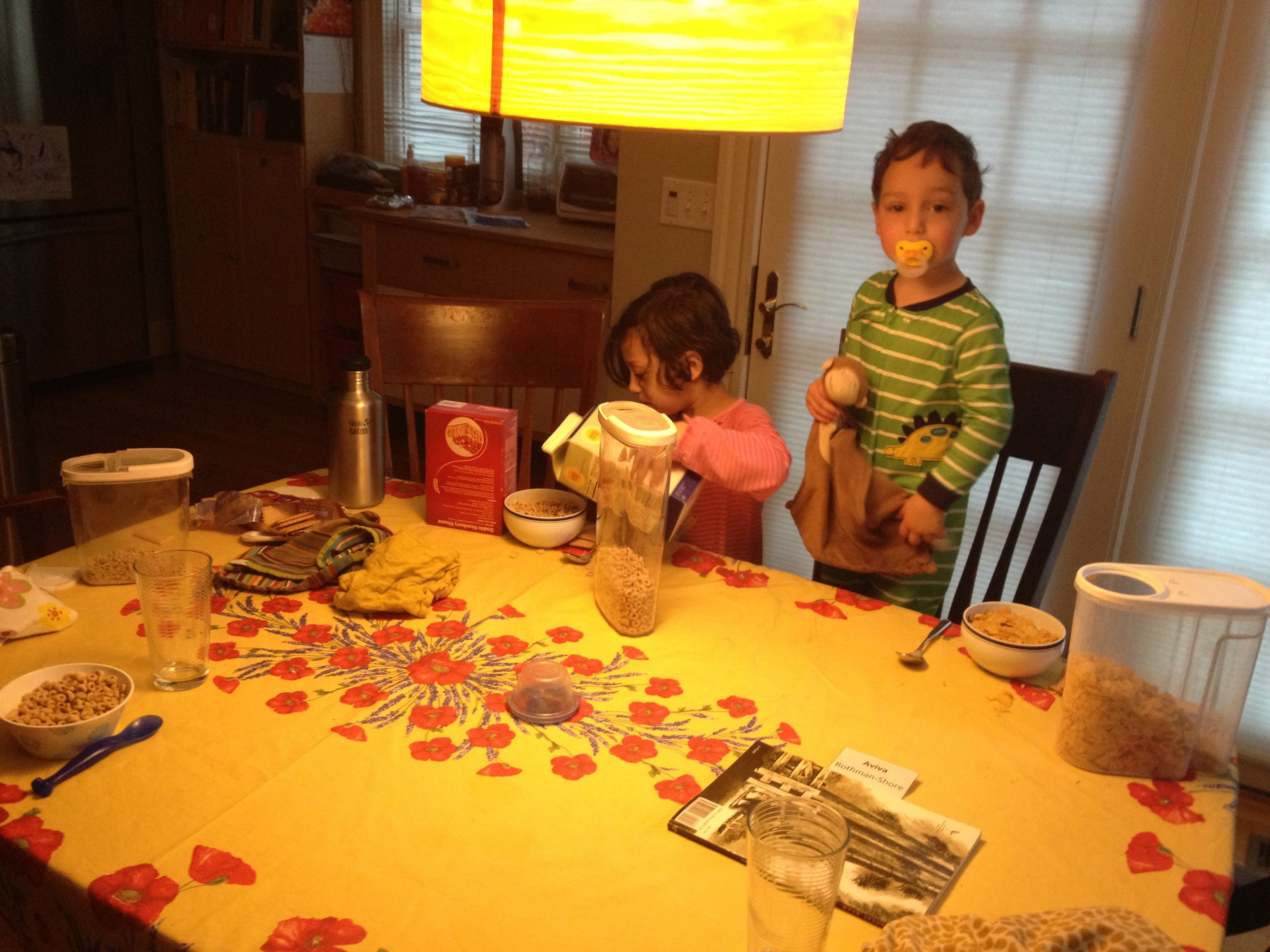
Four bowls of cereal and milk, four spoons, biscuits, and glasses of water, all on their own.

Four bowls of cereal and milk, four spoons, biscuits, and glasses of water, all on their own.

It was really quite civilized.  And they did it all by themselves.

I was shocked.  Even in my wildest dreams, I had not expected such a successful…and clean… first outing.

The funny thing was that once it was all set up, they decided to go upstairs to the third floor and play.  They never bothered to eat.  I had to cajole them to come back downstairs and eat with me to get them to actually have breakfast.

I suspect that a big part of this elaborate breakfast preparation was the novelty.  Because they were on a big adventure, they were working together and taking great care with all the details.

I have no doubt that tomorrow they will refuse to go on their own, or if they do, I will have that big mess we were all expecting.

But now I know for a fact that they can do it.  They day where both parents can stay in bed while they make their own breakfasts are in reach.

Posted in Uncategorized | Tagged , | 2 Comments

Caught cheating while reading my daughter’s bedtime story

“Daddy, you don’t have a very good brain!” my daughter reprimanded me this evening during bedtime.

I had skipped a sentence while reading her bedtime story, and she had caught me red handed.

She went on to explain to me that I missed some words, and I should have said”‘I think it is time for you to go to school now’, said Mother.”

Sure enough, that’s what it said.  I stared at her, flabbergasted.

The last step in our bedtime routine is that each kid gets to pick a story for me to read to them.  Usually, this passes without incident, but there is occasionally a negotiation when one of the kids picks a story that is just too long for an expedient bedtime.

At the ages of almost three and five, my kids still like to hear some stories over and over, so reading a long story night after night can get very tedious.  Even really well written longer stories like Miss Rumphius by Barbara Cooney can start to drag if we don’t mix it up a bit.

But the real bane of my existence is the Frances book series by Russell and Lillian Hoban, particularly Bread and Jam for Frances.  It tells the story of a badger named Frances who refuses to eat anything but bread and jam and her parents’ struggle to get her to try new things.

Bread and Jam for Frances is a loooong book (picture from Barnes and Noble)

Bread and Jam for Frances is a loooong book (picture from Barnes and Noble)

Now, as the parent of some very picky eaters I can relate.  But it’s so…damned…long… and my daughter Ayelet absolutely loves it.

This isn’t one of those picture books with a few sentences per page.  It has whole pages with nothing but text interspersed with occasional pictures.  There are two whole pages devoted to a detailed accounting of how Frances’ friend Albert eats a five course lunch.  I kid you not.

I swear I would have no trouble telling this story in 1/3 the space.  And to be truthful, I sometimes do.

On the nights that I cannot manage to steer Ayelet away from it, I have taken to playing a bit of “editor”.  There is a lot of needless dialog, and since she can’t read yet, she doesn’t really notice if I skip a sentence here and there as long as it’s not key to the story.  And there are a lot of these sentences.

So, when I agreed to read Bread And Jam again tonight, I was unprepared for what happened next.  She immediately started making corrections.  I would skip a line and she would immediately point out my mistake and tell me what I should have said.

At times, Ayelet’s memory amazes me.  She can rattle off details about a house we visited on a trip over a year and a half ago, and she could recognize every letter of the alphabet before the age of two.  I had always assumed she would be an early reader, but she never showed much interest in putting the letters together.  She has learned several sight words  at school, but she is nowhere near advanced enough to be reading this book with me.

My best guess at this point is that someone read the book with her earlier in the day and so it was fresh in her very good memory.

If not, an absent minded father like me is going to find himself in a lot more trouble as she gets older.

Posted in Uncategorized | Tagged , | 1 Comment

How I became one of those jackasses with a bluetooth headset

I hate to admit it, but it’s not uncommon to find me wandering around with one of those bluetooth headsets sticking in my ear.  I am the first to admit that it’s not exactly fashionable, and I hate the image it projects – “I’m so damned important that I need to be able to answer a phone call in less time than it requires to take my phone out of my pocket.”

Years ago, I swore off bluetooth after a terrible experience trying to use a headset with my Palm Treo 650.  For starters, the handoff between the phone and the headset was never smooth.  The phone wouldn’t realize that the headset was there, and it would take an agonizing couple of seconds when I answered the phone to route properly.  Sometimes it would never route at all, and I would have a confused moment trying to talk into the headset while the call was still on the phone.

Worse, no one could hear me.  “Could you speak up?” “I’m sorry, could you repeat that?”

Plus, it was another device that needed to be charged regularly.  Why bother?

Now, after seven years, I decided to give bluetooth another look.  In my new job, I am on the phone a lot, either on my cell phone (we’re a startup and don’t have landlines) or on my computer using voip conference tools like WebEx, GoToMeeting, and Skype.  Much of the time I tried using my Apple Earpods, but several people were having trouble hearing me.  Also, I often like to pace when I talk, and the cord was keeping me chained to my laptop.

One of my colleagues uses a bluetooth headset and swears by it.  I’m convinced he spends about 70% of his waking hours on phone calls, so I figured if he uses it, it must really work.  Perhaps the technology has improved.

The Plantronics Voyager Legend has a boom microphone for better voice pickup

The Plantronics Voyager Legend has a boom microphone for better voice pickup

I selected a Plantronics Voyager Legend.  The most important thing to me was that people be able to hear me well, and Plantronics has a strong reputation building headsets for use in office phones.  This model was bulkier than some other headsets, but it had a nice, long boom microphone that would hopefully pick up my voice well.

Another nice feature is that it has multi-pairing, where it can be connected with several devices simultaneously.  This meant that I would be able to switch between using it with my laptop and with my iPhone seamlessly.

To my amazement, when I got the headset and tried it out, it really worked.  All of the problems I had with my old Treo were gone.  Handoff between the iPhone and the headset was seamless, and I could press a button to swap back and forth instantly.  Best of all, people could actually hear me.  My father, who is constantly complaining about an inability to understand me, says it’s the best I have ever sounded on any phone.

The Plantronics Voyager Legend has another cool feature – a capacitive sensor on the headset itself.  It knows when you put it on or take it off and behaves intelligently.  If my phone is ringing and I put the headset on, it automatically answers the call.  If I take it off,  it routes the call back to my phone.  It’s a small detail, but one of those touches that really makes it useful.

So far, so good.

The thing about the headset is that it works well enough that I find myself using it for more things than phone calls.  I listen to NPR podcasts while driving, and the iPhone naturally streams them to my headset.  When I reach my destination, I’ve found myself routing the podcast to the headset so that I can keep listening while I walk from the car or run into the store.

One of its most unexpected uses came the day of the Boston Marathon bomber manhunt when I was sheltering at home alone with the kids.  I wanted to follow the news while attending to the kids, but I was trying to keep them unaware of what was going on.  I realized that I could wear the headset and stream NPR from my phone so that I could hear, but they couldn’t, even as I was sitting with them at lunch or helping them with their coloring books.  Late, that day, when we had evacuated to Providence to pick my wife, I was using its hands-free Siri integration to coordinate with her via text message while I walked around searching for a bathroom for my daughter and carrying my son.  It was invaluable.

It really does deliver on the convenience they promise, so I find myself using it.

Even if it does make me look like a jackass.


Posted in Uncategorized | Tagged , , , , , | 8 Comments

Trying out GoldieBlox on my five year old daughter

When I wrote about introducing my daughter Ayelet to legos a couple of weeks ago, a friend suggested I take a look at GoldieBlox.  The idea was to design a construction toy set that was geared towards girls and finding ways to engage them in building.

Created by a female engineering grad from Stanford, the idea behind the toy was to build a story to associate with the blocks.  As the child read or listened to the story, she could follow along and build the same machine as the character.  The theory was that for girls, having a story would provide some purpose and narrative to the activity, while boys might generally be more interested in construction for construction’s sake.

I’m not expert in gender psychology, and I know there is a broad range in both boys and girls, but I could see how my daughter might very well become more interested if there was a story behind the project.  Plus, GoldieBlox was a small scale kickstarter funded project, and I wanted to support the effort.

Production was still ramping up when I placed my order at the beginning of March, so it it took about 8 weeks before arriving on my doorstep yesterday.  When my younger son Rafael went down for his nap, I took advantage of the one-on-one time with my daughter and pulled out the GoldieBlox.  She was immediately attracted to the bright pink box and eager to start.

The pink box was a hit

The pink box was a hit

As it turns out, the story that comes with the blocks was not much of a story at all.  For no apparent reason, the character of Goldie Blox decides she wants to build a spinning music box for her dog, and then eventually a bunch of other animals want to spin too.  It’s not particularly clear why, and it failed to capture my daughter’s interest in a story, which was supposed to be one of the central ideas behind it.

The pink ribbon and rubber animals held her interest, despite the lack of a real story to go with them

The pink ribbon and rubber animals held her interest, despite the lack of a real story to go with them

Nonetheless, my daughter liked the rubber animals that she could attach to the posts, and she was excited by the pink ribbon that causes the spindles and animals to turn.

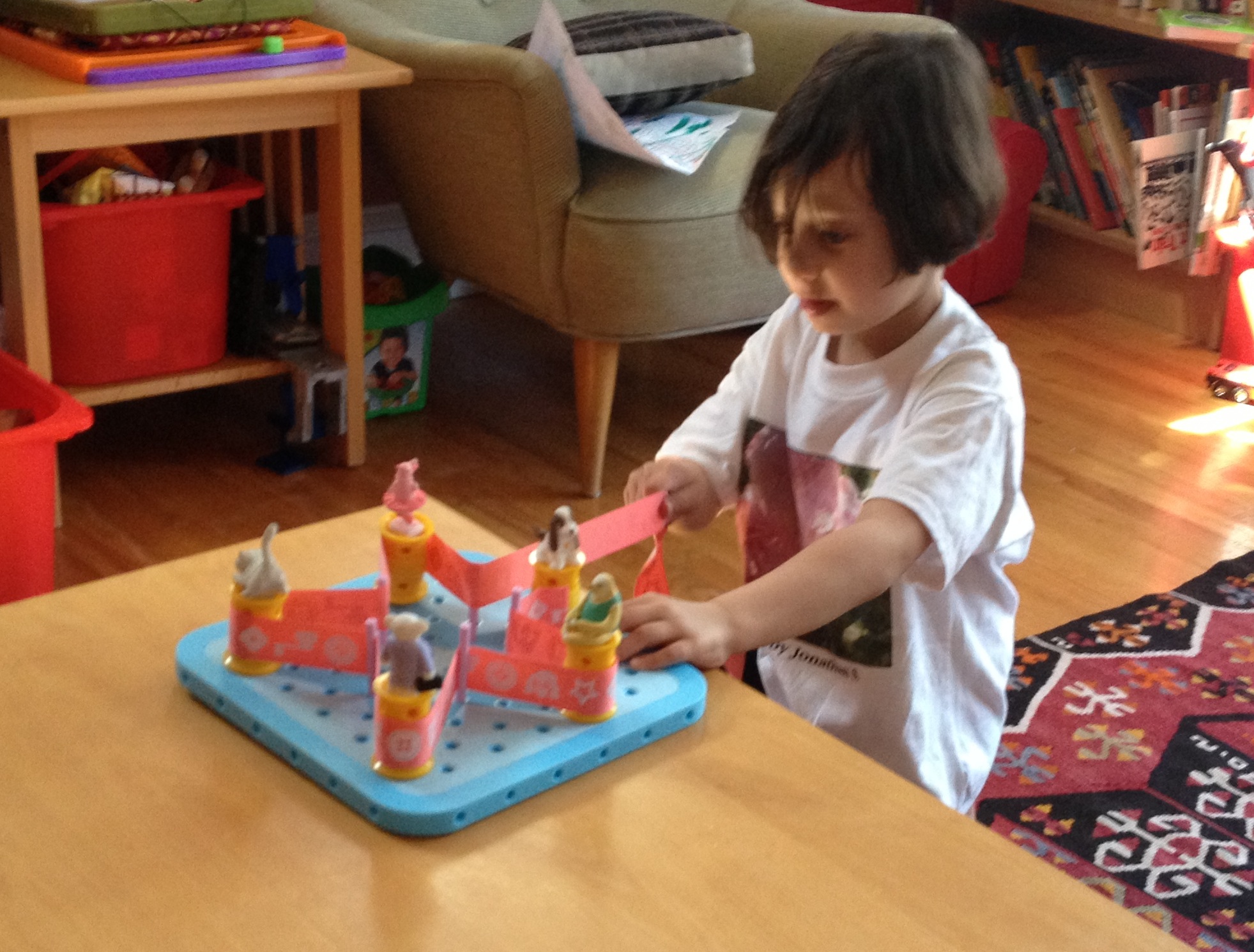
GoldieBlox, fully assembled

GoldieBlox, fully assembled

With my guidance, she made it through all of the steps to the end of the story.  The toy is intended for ages 6+, so she is just a little too young to do it on her own and needed some help figuring out how to wrap the ribbon to make all the spindles turn at once.

The “story” of GoldieBlox ended, but there were some more pictures of other creations you could make.  However, at this point, Ayelet was ready to be done and asked if she could go watch TV.

Shortly thereafter, Rafael woke up and came into the living room.  He immediately saw the GoldieBlox board and said, “What’s that?”

Rafael immediately gravitated to the GoldieBlox

Rafael immediately gravitated to the GoldieBlox

He proceeded to start playing with the board, turning the spindles and pulling on the ribbon to make them turn.  We didn’t discuss the story, and he was only vaguely interested in the rubber animal characters.  He wanted to pull off and reattach the spindles.  It just naturally held his attention.

My sample set of one boy and one girl is vastly insufficient to draw any conclusions, but it does fit in with the stereotype of boys being naturally more inclined to build and assemble with blocks.

I think GoldieBlox has a great idea of using a story to engage girls in building, although I must say that I had hoped for a more engaging narrative.  I had assumed that Goldie would have to some how build a contraption to solve some larger problem that my daughter could relate to, whereas the actual reason for the building seems rather arbitrary.  Also, the “advanced activities” are all about making interesting designs, for which the moving ribbons and spindles seem rather extraneous.  But these are easy criticisms for me to make on the sidelines.  The challenges of building an affordable product and concise enough story to fit into a printable book are huge, and I don’t know that I could do better.

I did notice that someone clearly put some thought into the modularity of the board.  I spotted some holes in the side that would allow spindles to be attached horizontally rather than vertically.  After dinner I showed Ayelet and Rafael how we could attach spindles to the top and the side to create an elevator for the rubber animals.

Using holes on the side, I showed the kids how we could make an elevator

Using holes on the side, I showed the kids how we could make an elevator

Rafael liked turning the crank, but my daughter enjoyed making the animals go up and down.  A different approach for each of them.

Posted in Uncategorized | Tagged , | Leave a comment

A parent’s emergency mnemonic for bolting out the door with kids

Friday, April 19th was a hell of a day here in Cambridge.  In the wake of the Boston Marathon bombings, several communities went into lockdown as the police combed a 20 block area of nearby Watertown searching for the remaining suspect.  In an effort to find him, all residents were asked to say in their homes while police went door-to-door.

I had been up for several hours the night before when I was awoken by the constant rush of police cars near my house (the bombers had released a hostage at a gas station two blocks from my house), so I wasn’t completely surprised when a Cambridge code-red alert announcing the lockdown came in at 6am.  My daughter Ayelet (age 5) and son Rafael (age 2) had just woken up and crawled into bed with me.

“Okay guys, school is closed today,” I told them.  “Um…let’s make pancakes!”

I’m not much of a cook, but I had a long day ahead.  My wife was in New York City visiting a friend and scheduled to return by train later that afternoon, so I was going to be on my own.

The day passed in a blur.  The kids watched a ton of TV, played on our upstairs balcony, and squabbled over coloring books.  In the midst of trying to mediate, I was handling work calls and emails and trying to discretely follow the amazing news events unfolding around me.  I was constantly on the go, jumping from one thing to another.  It was exhausting.

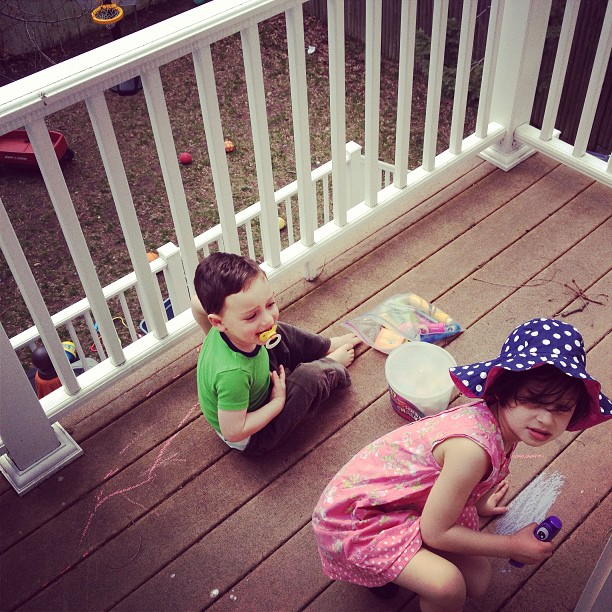
Unable to leave the house, the kids drew with chalk out on our balcony

Unable to leave the house, the kids drew with chalk out on our balcony

Then my wife called with the news that her train was canceled.  Faced with the possibility that I was going to continue the solo act for perhaps another full day, I put on a brave face, but she quickly figured out that she could get on a bus that would get her as far as Providence, just an hour away.  Technically, Cambridge was on lockdown, but my sense was that no one was going to stop me if I got in a car and hopped onto the Masspike, which is right near my house.  So, we agreed the kids and I would pick her up there.

When it came time to throw the kids in the car, everyone’s patience was running thin.  My son hadn’t napped and was having a tantrum on the floor and refusing to put on socks.  My daughter was gathering a mountain of books.  I was mentally exhausted and needed to get both kids ready for a two hour car ride, there and back.

At times like this, I fall back on a mnemonic that I started using when my daughter was just 15 months old and we were traveling in Italy.  We would inevitably forget something when going out for the day, so I came up with “Big Jumping Penguins Don’t Sing With Turkeys”.  As long as I followed it, I would have everything I needed for the kids:

  1. Big = “B” = bib (a handy bib for easy, no mess meals when out and about)
  2. Jumping = “J” = jacket (make sure they don’t get cold ; substitute a hat in warm weather)
  3. Penguins = “P” = pacifier (in case of a meltdown)
  4. Don’t = “D” = diapers (’nuff said)
  5. Sing = “S” = snacks (they will get grumpy if they get hungry and you have no food)
  6. With = “W” = water (playing can be thirsty work)
  7. Turkeys = “T” = toys (a great distraction)

In my dazed state, I started running down the list.  “B=bib”: I didn’t need a bib anymore, since they kids are much older and eat without big messes. “J=jacket”: I tossed some jackets in a bag; no need to put them on now, just get them in the car. “P=pacifier”: I put my son in the car seat and stuck it in his mouth, knowing he would konk out for a nap within 10 minutes that way. “D=diapers”: I threw the miniature diaper bag in the car. “S=snacks”: We had a snack pack ready to go from when we expected my mother-in-law to be picking the kids up from day care. “W=water”: I filled two water bottles. “T=toys”: I took the giant pile of toys and books my daughter had gathered and dumped in the car – at that point, I didn’t care how large it was.

Within five minutes, we were in the car and on our way to highway.  I was tired, but I knew I had everything I needed since I had followed the mnemonic.

As we drove down to Providence, we used almost all the items.  Ayelet ate snacks, drank water, and she looked at her books.  She used a coat to wrap on her legs as a blanket.  Rafael quietly napped and sucked on his pacifier.

Then, about 10 minutes out from Providence, we hit a major traffic jam due to a car accident.  Suddenly, my daughter said, “Daddy, I have to go to the bathroom!”

Uh-oh.

The mnemonic was created when she was just 15 months old.  This was long before toilet training, and I had never updated it to include a bathroom trip.  It had failed me!  Now we were stuck in traffic without a bathroom.

I managed to keep her distracted long enough to get past the accident and park at the Providence Mall, close to where we would be picking up my wife.  As my bad luck would have it, the mall was being evacuated due to a fire alarm, but we soon found our way to a nearby hotel and a bathroom she could use.  Crisis averted.

Soon, we were reunited with my wife and back in the car, returning to the Boston/Cambridge.  As we drove, I was telling her about the stressful day, how the mnemonic had once again come in handy, and how it was out-of-date.  I was thinking I was going to need to add another letter when we both realized that we already had one.  “B=bib” was no longer needed, but it could now become “B=bathroom”!

And so, the advice still stands.

Big Jumping Penguins Don’t Sing With Turkeys.

Posted in Uncategorized | Tagged , , , | 3 Comments

TripIt Pro is absolutely worth the money, even if you travel infrequently

I’ve been using the free version of TripIt for years as a way to keep track of the reservation details of flights, hotels, and car rentals.  It’s brilliantly simple – you take the confirmation emails that you receive when you make your reservation and simply forward it to “plans@tripit.com”.  It recognizes your sender email address and automatically parses out all of the information and builds an itinerary for your trip.

The beauty is that you no longer need to keep track of the reservation emails, and it doesn’t matter which airline or service you use – all of the information is extracted and stored in a common format – reservation numbers, seat assignments, record locators, contact information for the airline, etc.  Their mobile application becomes your one-stop shop for all of your travel details.  Even if you travel once or twice a year, it’s incredibly useful and costs nothing.

All reservations have been organized in a consistant format and arranged into an itinerary.

All reservations have been organized in a consistant format and arranged into an itinerary.

TripIt makes their money by offering a professional version for $50 that offers flight tracking. They will monitor all of your reservations and update information with gate information and alerts if there is a delay or cancelation.  Every time I have traveled I have wished I had this feature, but I’ve always been too much of a cheapskate to sign up for it.

My new job requires more travel than my old one.  Not a ton, but I do have three trips for work as well as a personal vacation over the next few months, so I decided to splurge for TripIt Pro ahead of my trip to Minnesota this past Monday.

As soon as I upgraded, TripIt immediately started to warn me that my return trip had a “Connection At Risk”.  Our layover in Chicago was only 45 minutes, and it was alerting me to the fact that we might not make it.  It also had gate numbers and airport maps, and I could see that we would have to cross half the airport to make it to our connecting flights.  Well, risky was right.  At least I knew what I was in for and which way to turn when we stepped off the jetway.

Our trip out to Minnesota was uneventful, and as our meetings were wrapping up, we were chatting with our client about a storm expected that evening.  They commented that it was a good thing we were getting out ahead of it.  Naturally, my phone buzzed right at that moment with a TripIt alert.  Our flight was delayed one hour, and TripIt now reported what we will definitely miss our connection.

The alert tells us which flight is delayed and notifies us that we will not make our connecting flight

The alert tells us which flight is delayed and notifies us that we will not make our connecting flight

As we dashed to the airport and had an colleague back at our office looking into flight alternatives, my phone continued to buzz with updates on gate changes and schedule adjustments.  As luck would have it, our Chicago flight was delayed as well, so TripIt put it back into the “Connection at Risk” category.  I could also see from the airport maps that the new gate assignments were right next to each other, so there was  hope.

15 minutes into the ordeal, I received an automated phone call from American Airlines about the delay, long after TripIt had sent its first notification.  The airline left an automated voicemail that went on 45 seconds and was hard to piece together the information.  TripIt was giving me updates much sooner and much more focused on the key data I needed to know.

In the end, my boss was able to use his executive status with the airline to get our whole party bumped onto a different airline with an on-time direct flight, so we never had to find out whether we would make it through the Chicago airport.

However, the fact that Tripit alerted us to the situation so early and kept us up-to-date was invaluable.  It prompted my boss to work his magic and get our flights switched.

Absolutely worth $50 a year.  Even from a cheapskate like me.

Posted in Uncategorized | Tagged , , , , | 4 Comments

Every homeowner should buy a wet vac

I keep a superhero hidden in my basement.  We don’t need it very often, and so it generally sits quietly in the corner, ignored by the other household members.  Then, when disaster strikes, it comes roaring life, appearing out of the hidden shadows like Zorro to save the day.

The wet vac!

A wet vac is basically what it sounds like – a vacuum cleaner that can handle sucking up liquid.  It first came into our lives many years ago when we first moved into our house.  It was a new house built on top of an existing foundation, and we were the first owners.  In theory, new construction is great because nothing is wearing out, but you also have the flip-side problem of not having worked out any bugs.

When a massive, five day rainstorm came along, gaps in the old foundation couldn’t keep the water at bay, and one half of our basement started to flood.  We had a sump pump, but it was at the other end of the basement, and we would need several inches in one end before it would get deep enough to reach.

Desperate for some way to pump it out, I wandered into Home Depot late one Saturday night looking at wet vacs.  I found a giant 16 gallon one that had wheels and a drain spout on the bottom.  After bringing it home, I spent the next several hours sucking up water at one end of the basement, wheeling it over to the other end, and then emptying it out into the sump to be pumped out, then back again to fill up the tank.

16 gallon capacity with caster wheels and a discharge spout at the bottom

16 gallon capacity with caster wheels and a discharge spout at the bottom

It saved the day, and then I tossed it into the corner.  We had a waterproofing company come in and create a water barrier near the exposed foundation and install a second sump pump nearby, and the basement stayed dry.  The wet vac was more or less forgotten.

Five years later, we discovered that the new sump pump had failed.  Of course, we did not learn this until a hurricane came through and dumped a large amount of water into the already saturated ground.  Once the water level got too high in the sump pump, a moisture alarm started to ring, and I opened it up to discover the issue.  We were going to need to get someone in to replace the sump, but that wasn’t going to happen in the midst of the storm.  I needed to pump the water out some other way before we it started to flood.

I remembered my 16 gallon wet vac, sitting in the corner, long ignored.  I plugged it in and found that it was working just as well as when I bought it.  I was able to use it to transfer water from the failed sump pump over to the working one, and we thus avoided new flooding.

Again, the sump pump sat idle for two years until a far more serious problem reared its head this week.  It turns out that tree roots outside the house had grown their way into the pipe that connects our house’s plumbing system to the Cambridge sewer system.  This caused a backup with surprising effects – when we drained the tub after bathing our kids on the second floor, the water was unable to drain into the sewer and instead caused a flood in our first floor bathroom as it sought some other place to go.

Water is just a horrible thing for a house.  Wood can warp, mold can grow, walls can be ruined.  We needed to clean up the water fast before it became a far more serious issue.  After starting to ineffectually mop it up with towels, I suddenly remembered… the wet vac!

Once again, it saved the day.

If you are a homeowner, buy a wet vac.  Once every five years, you will consider it one of the best purchases you ever made.

Posted in Uncategorized | Tagged , | Leave a comment

Shortcut: cleaning oily or greasy tupperware containers by hand

Over the holiday of passover, I find myself doing a lot more dishes than normal. We use completely separate dishes for the holiday, since the requirement to eliminate all chametz (leavened products) extends to all of our regular dishes, which have been contaminated from contact with bread products over the course of the year. It’s kind of like cooties.

The chametz prohibition extends to our dishwasher as well, so that means that all dishes during the eight day holiday have to be done by hand. It really makes you appreciate the modern convenience of the dishwasher during the rest of the year.

Dishes, glasses and pots aren’t so bad, but what really drive me nuts is the tupperware.  I don’t know why, but there is something about plastic that makes it a magnet for oil and grease.  You scrub it with a sponge, soap, and hot water, and you find that it still has a slippery film coating it.

Someone once taught me a trick for how to clean oily tupperwares, and since we are still halfway through the holiday, I thought I would pass it along to my fellow Jews slaving away washing their pesach dishes.

The secret is to eliminate the water and sponge and just use the raw grease cutting power of the soap directly.  Here are the steps:

  1. Remove any food reside from the tupperware (you can use water for this, just make sure to shake the water out so that it doesn’t pool at the bottom).
  2. Put a squirt of soap directly into the container.
  3. Use your fingers to spread the soap all along the inside surface of the tupperware.  It’s kind of like finger painting. (Add more soap if necessary)
  4. Once the whole inside of the tupperware is thinly coated in soap, rinse it out with hot water
  5. Dry the tupperware with a hand towel

When you are done, you will find the container squeaky clean with no oily residue.  I’ve done with with all kinds of food, including greasy meat or chicken that leave hard to remove fat.  It works like a charm.

So yes, the answer is just soap.  Not a trick really, more a technique for exactly how to use it.

Passover is more than half over.  Hang in there!

Posted in Uncategorized | Tagged , , , , | 6 Comments

Shortcut: Create a spot in the Mac OSX Dock for a Chrome link

At my new job, I have had the luxury of using a Macbook Pro for my work computer instead of a Windows machine.  Overall this has been a significant upgrade, but there have been a handful of areas that I have struggled with in adapting to the OSX environment.  A big part of my pain is learning all of the keyboard shortcuts for Microsoft Office for Mac, which have little overlap with its Windows older sibling (I can’t tell you how many times muscle memory has caused me to minimize Powerpoint when I meant to create a new slide).

One thing that I have really missed is the ability to create application shortcuts in Chrome.  In the Windows version of Chrome, I could take heavily used web pages (like email or application monitoring tools) and give them their own application icon.  This gave them their own place in the dock, and its own icon in the alt-tab view for quick application switching.

For some reason, the Mac version of Chrome doesn’t have this option.  To make matters worse, Macs hide each application’s various windows from you.  Alt-Tab only allows you to switch between applications, and then once you are inside, you have to use Alt-~ to switch between the windows.  I know that Mission Control allows you to see all the windows, but if you have a lot of applications and windows running at once, this is information overload.  It’s hard to find the one you want.

Today I was experimenting with the much talked about Trello for task and project management, and I found myself desperately wanting to give Trello its own spot on the doc.  Every time I wanted to pull it up to make an update, I had to Alt-Tab over to Chrome, then Alt-~ to the correct chrome window, and then find the Trello tab.  I needed a better solution.

A quick search led me to CreateCgApp.  You simply run the application, give it a link, give it an icon, and voila, you have your own separate window and dock for a Chrome application.  You can alt-tab to it, and it even gets its own spot in Mission Control.

Creating a standalone Chrome shortcut in the doc is as easy as 1-2-3

Creating a standalone Chrome shortcut in the doc is as easy as 1-2-3

Just what I needed.  Now I can pull up Trello any time, easily.

Trello now has its own spot in the dock

Trello now has its own spot in the dock

Posted in Uncategorized | Tagged , , | Leave a comment

The secret of how Magna-Tiles work

Like many kids, my children love Magna-Tiles.  For those not familiar with them, they are transparent plastic squares and triangles with magnets embedded around the edges.  When two Magna-Tiles are placed edge-to-edge, the magnets stick together, allowing you to build structures just placing them next each other.

What’s really great about them is that the magnetic attraction is perfect for beginning builders.  Because pieces naturally stick together, you don’t need much precision to place pieces correctly (as opposed to Legos, which need to be perfectly aligned), and they can defy gravity in a way that blocks cannot.

My two-year-old son building with Magna-Tiles

My two-year-old son building with Magna-Tiles

I’m one of those people who always wants to understand how things work, and there is something about the Magna-Tiles that bothers me – they never seem to repel each other when you build with them.  Magnets are polarized, with a “North” side and a “South” side.  If you pick up two regular magnets, the north and south sides will stick together, but you can’t connect two Norths or two Souths.  I see this most often with my kids’ wooden train sets, where the cars are connected with magnets.  To connect two cars, they have to be oriented with the North/South polarity matching.  If one is facing the wrong way, they push away from each other rather than sticking.

Magna-Tiles don’t seem to suffer from this problem.  I can rotate the pieces in any orientation or flip them over, and they always stick.  Shouldn’t there be “correct” and “incorrect” alignment?  If they stick together one way, which means the North/South poles are matched correctly, shouldn’t flipping the piece around cause it to be incorrect?

I tried googling this and have found some other people who are as puzzled as I am but no clear explanation.

The other day, it finally dawned on me how they must work, so I figured I would share for other curious parents.

The first part of the secret to the Magna-Tiles is that the North-South direction is not along the edges, but rather in the Z-axis.  If you lay a Magna-Tile flat, think of the four edges as the four directions.  The poles of the magnets, however, are in the up and down direction, not out along one of the sides, as I had originally assumed.

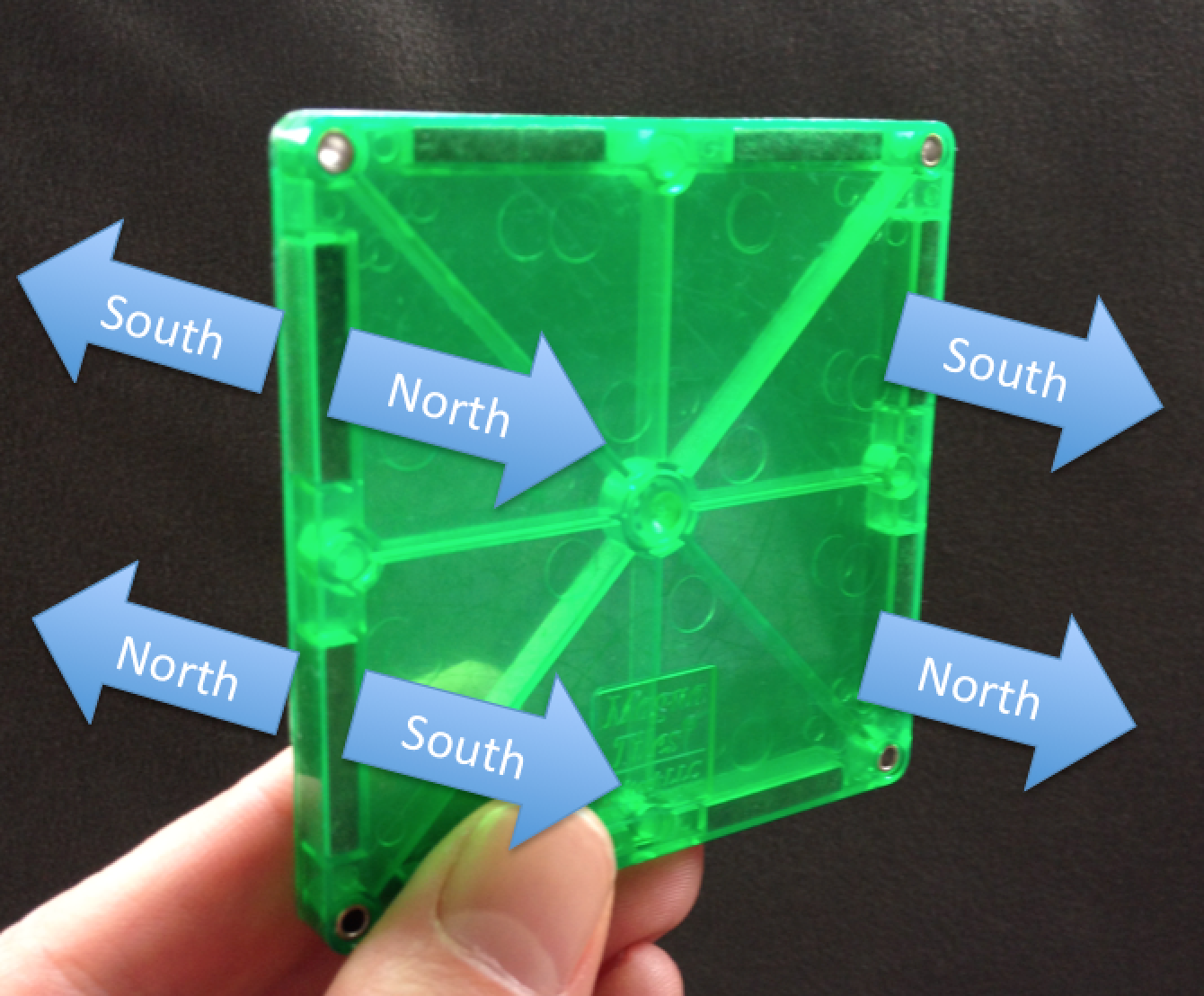
The second part of the secret is that each Magna-Tile has two magnets on a side, and these magnets are oriented in opposite directions.  So, if the one on the left has North pointing up, the one on the right has North pointing down.  This continues around all four edges of the Magna-Tiles, with each magnet having the opposite North/South alignment of the ones on either side.

I’ve tried to illustrate with this crude diagram.  As you can tell, my background is in software engineering, not graphic design:

The magnetic poles are aligned along the "Z-Axis", and each magnet alternates the North/South direction of the poles

The magnetic poles are aligned along the “Z-Axis”, and each magnet alternates the North/South direction of the poles

Because of the alternating pattern with two magnets per edge, there is no way to place two Magna-Tiles next to each other such that the magnets are facing the opposite direction.  Regardless of whether you rotate it or flip it around, you always have the configuration of magnets and polarity.

And, most crucially, if you place two tiles next to each other, the adjacent magnets have poles facing opposite directions in the Z-axis, which means they will stick together.  In other words, the left tile’s north side touches the right tile’s south side, and vice versa.  And so they stick.

The only way to make two Magna-Tiles repel each other is to place them misaligned, with  the top half of one touching the bottom half of the other one.  Then you will find the magnets repelling each other.  However, since this is not a normal way to attach Magna-Tiles when building a structure, it doesn’t happen much in practice.

I hope this explanation makes sense.  If  not, try playing around with some Magna-Tiles while keeping in mind that the North-South is facing up and down on the Z-axis, not the X-Y axis of the Magna-Tile itself, and you will see what I mean.

Happy building.

Posted in Uncategorized | Tagged , , | 19 Comments